
It is important to know how the search engine algorithm works with links. There are two key metrics in links, quantity and quality. Based on them, the importance of a website can be determined.
The name given to these metrics depends on the software or tool that measures them and they are not official from Google, so we will always take them as a reference.
Below we will see an approach to how the variables are related in the SEO link algorithms and then the link SEO metrics of each specific tool.
How does Google algorithm work with links?
We start with website A that doesn’t link to anyone. We assume that its importance or quality is 100:

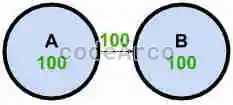
Now suppose that this website links to another site B which has an importance of 0. This results in site A transmitting its importance to site B, which also has a score of 100:
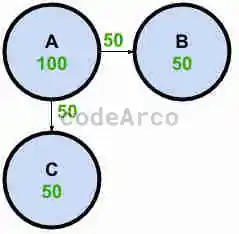
Now suppose that site A not only links to B, but also to a third party, C. The importance is distributed equally between B and C, giving each an importance of 50:
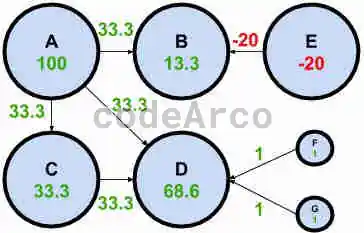
Finally, let’s assume that 3 new websites come into play. One of them, website D, to which sites A, C point. Then we have two sites, F and G, with an importance of 1 and they point to D. In addition, site B is now pointed to by a new site E with a negative importance of -20.
Site A equally distributes its importance to B, C and D (33.3), site D obtains both the proportional part of A (33.3), C (33.3) and the two sites with importance of 1, remaining at 33.3 + 33.3 + 1 + 1 = 68.6. Site B obtains the proportional part of A (33.3) and the part of E (-20), remaining at 13.3:
Once we have understood the above, it is time to forget it. This is not how it really works, it is a very simplified example of the link algorithm but it will help us get a pretty good idea.
SEO Off Page metrics on links
In the market there are multiple metrics to analyze, each in its own way, the importance of a website based on the quantity and quality of its links.
It must be taken into account that some of these SEO Off Page metrics are applied at the level of:
- At the domain level. It will indicate the importance of the domain or the entire website based on the quantity and quality of the links that point to it in general. A good domain level metric is difficult to achieve, as it takes time and work.
- At the specific page level. It will indicate the importance of a specific page within a domain based on the quantity and quality of the links pointing to that specific page. A good page level metric is much more feasible to achieve since the content is centralized in a single place and we can analyze and change it easily.
In this article we are going to explain the metrics of Majestic, Ahrefs and Moz.
Majestic metrics, citation flow, trust flow and ratio flow
Majestic is one of the most famous solutions to measure the importance of a web page based on the quality and quantity of the links pointing to it.
The free version is quite limited as it only allows us to carry out a very limited number of daily searches.
An advantage of Majestic is that it allows you to obtain metrics both at the domain level and at the level of a specific web page within a domain. We can configure this when performing the search in the drop-down menu that we have in the search box.
Below we will see the most used Majestic metrics:
- Citation flow is the equivalent of the number of links. How important a domain or a specific web page is based on the number of links pointing to it. The value ranges between 0 and 100. Be careful with this metric, in everything related to SEO links, quality is preferable to quantity.
- Trust flow is the equivalent of link quality. How important a domain or a specific web page is based on the quality of the links that point to it. The value ranges between 0 and 100. This metric is much more valuable than the previous one, we will see why below.
- Ratio flow is the way through which citation and trust flow interact. The flow ratio is nothing more than the metric resulting from dividing the trust and the citation flow, its formula being the following:
RF = TF/CF
The optimal value of the flow ratio is 1 and the average is approximately 0.50. The higher this value the better. Obviously, the value of this metric can be between 0 and 1.
If trust flow increases, as a general rule, citation flow will also do so. However, the opposite does not have to be the case, that is, we can find sites with a high citation flow but a low trust flow. The latter are sites to which many websites point but these links are of low quality. The links from these sites are of no interest to us at all.
Moz metrics, authority domain and page authority
Moz, along with Majestic, is another of the most famous solutions for measuring the links that point to a website and the corresponding metrics.
Moz’s advantage over the competition is that the free version allows 10 searches per day, slightly more than the rest of its competitors. It also allows you to obtain metrics both at the domain level and at the specific web page level.
Next we will analyze the most used Moz metrics:
- Domain authority indicates the importance of an entire domain based on incoming links. The higher the value, the better. The value of this metric is between 0 and 100. A logarithmic scale is used, which means, in short, that it is much easier to increase the value when it is low and vice versa, it will cost more to increase it the closer it is to 100.
- Page authority is similar to domain authority except that instead of applying to the entire domain, it applies to a specific web page.
Ahrefs metrics, domain, url rating and rank
Ahrefs is another fairly powerful link checking tool, however, unlike Majestic and Moz, we can do much less for free.
The most used Ahrefs metrics are as follows:
- The domain rating indicates how important a domain is based on all links, both incoming and outgoing. The metric value is between 0 and 100 on a logarithmic scale.
- The URL rating indicates the same as the previous one but for a specific web page.
- Ahrefs rank refers to the position or ranking that the analyzed domain occupies with respect to the others, it is a kind of global ranking of web pages. Do not forget that it is an internal ranking of the Ahrefs company, it is not an official Google ranking.
What is the most important thing for SEO in links?
The conclusions that we can obtain from this article are, although we will talk a little more about it in SEO Off Page or links, strategy and tips, the following:
- Not only the number of links matters, but also the quality of the links. In other words, when it comes to links and metrics, quality is better than quantity.
- Links are not always positive, they can also bring us some SEO penalties.
- It’s not all about getting new links, it’s also about removing bad links. Site B in the example could improve its SEO Off Page just by removing the link from E.
- Not only major sites count, but also smaller or less important websites. Although not much, sites F and G in the example contribute to improving the importance and, therefore, the SEO Off Page of D.
Let us remember that the algorithm of the search engines and, more specifically, that of Google, is secret, therefore, the algorithm explained above and the metrics of the different systems are an approximation of how it works. This means that there will always be unknown variables and that no tool or metric is completely reliable.